The Future Isn't Deterministic: Why Simulation Matters More in an AI-Driven World
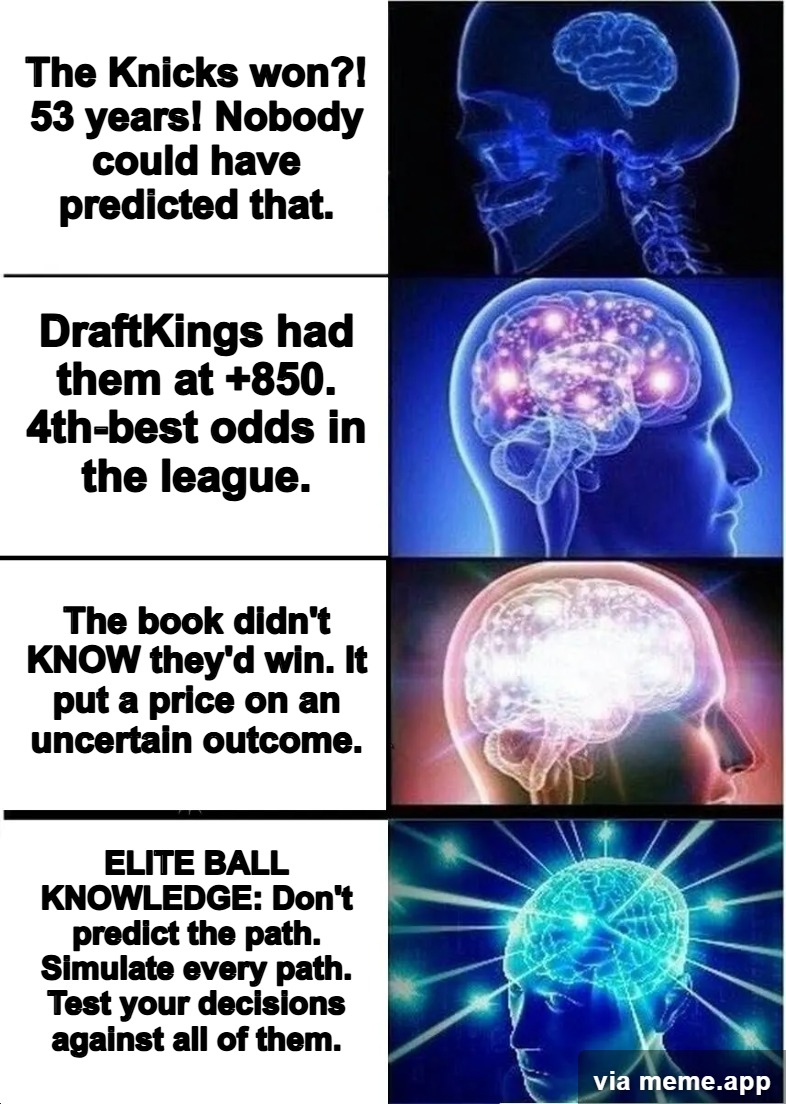
Shockingly, the Knicks ended their 53-year NBA championship drought. This is not the result that history would have foretold. But DraftKings had them at +850, the fourth-best odds in the league. Not bad for a team that had done nothing for multiple generations.
Safe to say the sharps have a pretty good model of the non-deterministic outcomes that NBA basketball produces. Of course, the oddsmakers didn't know the Knicks would win. They were assigning value to an uncertain outcome.
A complex system you can still reason about
Basketball is an extraordinarily complex system. Player performance, injuries, coaching decisions, matchups, fatigue, and countless interactions influence the result. Even with identical starting conditions, our ability to predict exactly how those interactions unfold is limited.
Yet we can build representative models that help us reason about the possible outcomes.
The value of a model isn't necessarily its ability to predict exactly what will happen. It's its ability to help us understand what could happen, under which conditions, and with what consequences.
That is the foundation of simulation.
Rather than committing ourselves to a single predicted outcome, simulation allows us to explore alternative scenarios, introduce uncertainty, test assumptions, and evaluate decisions against a range of plausible futures.
Now add AI actors to the system
Consider what happens when we introduce AI actors, nefarious and innocuous, into the systems and processes that businesses depend on.
- AI agents make decisions.
- Humans respond to those decisions.
- Systems change state.
- Information is incomplete.
- Processes branch in ways their designers may not have anticipated.
How do we engineer reliable outcomes when we cannot prescribe every decision or predict every interaction?
We simulate.
And importantly, we don't necessarily need a complete digital replica of reality to do it. We need a representative model that faithfully captures the relationships, constraints, and behaviors relevant to the decisions we're trying to make.
From "will it follow the path?" to "can it reach acceptable outcomes?"
Will this process follow the predetermined path we designed for it?
Can this process achieve acceptable outcomes across the many paths it might actually take?
The question becomes less about whether a process will follow a predetermined path and more about whether it can achieve acceptable outcomes across the many paths it might take.
That distinction is becoming increasingly important as AI moves from answering questions to participating in operational decisions.
Reason about the paths your processes can take
ViKeLaAi helps organizations model the relationships, constraints, and behaviors that matter to their security and readiness decisions, so they can evaluate outcomes before an AI actor, or an adversary, picks the path for them.