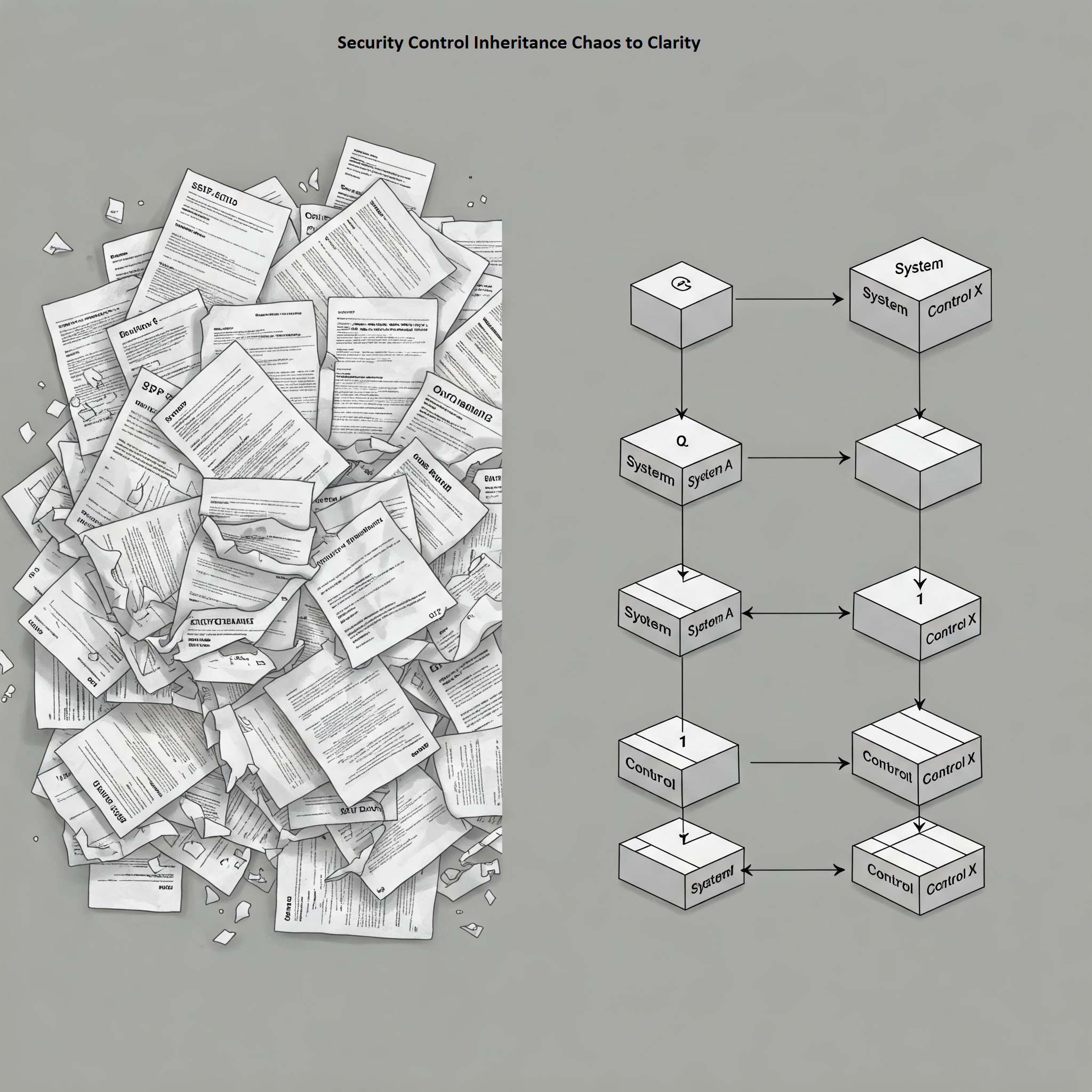
From SSP Overload to SRM Clarity: The Component Solution
Imagine a world of automated security control inheritance, where you can automatically quantitatively compare the security controls of different External Service Providers (ESPs) or automatically incorporate your ESP component implementations directly into your System Security Plan (SSP). This isn't science fiction; data standardization in the form of OSCAL and its <component> element are making this a reality. Forget the headache-inducing task of manually parsing lengthy System Security Plans (SSPs). Let's explore how OSCAL's building blocks can bring much-needed clarity to understanding security responsibility, starting with the creation of Security Responsibility Matrices (SRMs) that are actually useful for automation.
The Problem: SSPs and the Responsibility Black Hole
SSPs, while intended to be comprehensive, often fall short when it comes to clearly delineating who is responsible for what security control. They're typically massive documents, making it difficult to extract the relevant information, especially when dealing with the specific services an ESP provides or the intricacies of a complex internal system. Trying to map responsibilities from an SSP is often like trying to find a specific grain of sand on a beach.
OSCAL Components: The Key to Quatitative Clarity
OSCAL offers machine readable way. Its <component> element provides a structured and machine-readable way to represent distinct entities within your security ecosystem. Think of a component as a building block representing:
- A specific software application
- A hardware device (e.g., a firewall, a server)
- A cloud service offered by an ESP
- Even an organizational entity or team
Crucially, within each <component> definition, OSCAL allows for the detailed description of its capabilities and, most importantly, its relationship to security controls through the <control-implementation> element.
Connecting Components, Controls, and Responsibilities
The <control-implementation> section within an OSCAL component outlines how that specific component satisfies one or more security controls. This is where the direct link to a clear SRM emerges:
- Identifying Relevant Controls: For each <component> involved in a specific business process (e.g., handling FCI/CUI), the <control-implementation> section lists the applicable security controls.
- Describing Implementation: This section details how the component implements the control, providing crucial context for understanding the scope of responsibility.
- Explicitly Defining Responsibility: OSCAL's flexibility allows you to extend the <control-implementation> (or even the <component> itself) using the <props> element to explicitly define the responsibility for that specific control in relation to that component. For example:
    responsibility-type: "Responsible"
    responsible-party: "Network Security Team"
    accountable-party: "System Owner"
Building an Effective SRM from OSCAL Components
By leveraging the information within OSCAL Component Definitions, you can systematically generate a targeted and informative SRM:
- Identify In-Scope Components: Determine the specific OSCAL <component> elements relevant to the system or business process for which you need an SRM.
- Extract Control Implementations: For each in-scope component, extract the list of <control-implementation> elements.
- Identify Responsibility Properties: Look for the custom properties (using <props>) that explicitly define the roles and responsibilities associated with each control implementation for that component.
- Structure the SRM: Organize this extracted information into a clear matrix format, with security controls listed on one axis and the responsible components (or the organizational entities associated with them) on the other. The cells of the matrix can then indicate the level of responsibility (e.g., using RACI designations derived from the OSCAL properties).
The Benefits: Clarity, Efficiency, and Control
- Granular Detail: Provides a component-level view of responsibilities, moving beyond broad organizational assignments.
- Contextual Understanding: Links responsibilities directly to how controls are implemented within specific systems or services.
- Machine-Readability and Automation: Enables the automated generation and updating of SRMs, reducing manual effort and improving accuracy.
- Standardized Format: Facilitates better communication and understanding of responsibilities across different teams and organizations.
- Traceability: Creates a clear link between security controls, the systems implementing them, and the parties responsible.
Ditch the Document Dump, Embrace OSCAL
The traditional approach of relying solely on lengthy SSPs to understand security responsibilities is often a recipe for confusion and inefficiency. OSCAL, with its structured and machine-readable format and its powerful <component> element, offers a far more effective path. By embracing OSCAL, organizations can move towards a world of automated security control inheritance and achieve true clarity in responsibility management. It's time to demand better than the document dump – it's time to embrace the power of OSCAL.